
September 23, 2026

06 Market

Saudi pipeline shutdown threatens oil exports to Europe and Asia as kingdom relies on stored supplies www.euronews.com
News Source

EXCERPT:

Published on Updated

Saudi Arabia is relying on stored oil to maintain exports after drone attacks shut its East-West pipeline, threatening deliveries to buyers in Europe and Asia.

ADVERTISEMENT

ADVERTISEMENT

Saudi Arabia’s energy ministry announced the shutdown on Friday as a precaution, after the pipeline was attacked in the Riyadh and Medina regions last Thursday.

It said emergency and technical teams were securing the pipeline and checking its safety.

Saudi and Iraqi authorities said the drone attack originated in Iraq. The ministry’s announcement did not say when pumping would resume or give a full account of the damage.

Saudi oil buyers and traders quoted in reports published on Sunday estimated that a prolonged shutdown could put at risk around 4 million barrels a day, or about 4% of global oil supply.

They estimated that oil stored at the Red Sea port of Yanbu could keep exports going for five to seven days. Saudi authorities have not confirmed either estimate.

The effect on deliveries will depend on how quickly pumping resumes and how much stored oil is available.

Brent crude futures rose around 3% in early trading on Monday following further attacks on energy facilities and shipping in the Middle East.

A route around Hormuz

The roughly 1,200km pipeline carries oil from eastern Saudi Arabia to Yanbu on the west coast. It allows exports to leave through the Red Sea without tankers passing through the Strait of Hormuz.

Aramco said in May that it had increased pumping through the pipeline to its maximum capacity of 7 million barrels a day during the first quarter, helping maintain exports while shipping through Hormuz was disrupted.

The pipeline also supplies refineries on Saudi Arabia’s west coast, so its capacity is not the same as the amount exported.

The shutdown does not mean global oil supplies immediately fall by 7 million barrels a day. Tankers can still load oil stored near export terminals, but those supplies will run down unless more oil arrives.

Deliveries to Europe and Asia

From Yanbu, tankers heading to Europe can sail north through the Red Sea towards the Suez Canal and the Mediterranean. Egypt’s SUMED pipeline offers another route, carrying oil between the Red Sea and Mediterranean coasts.

The direct sea route to Asia runs south through Bab el-Mandeb, the narrow passage between the Red Sea and the Gulf of Aden, and then towards the Indian Ocean.

That route faces a separate threat from Yemen’s Houthis, who have seized Perim Island in the passage and the country’s Red Sea coast, effectively taking control of the strait.

Tankers heading to Asia could instead sail north through Suez and then around Africa, but the journey would be much longer. Changing a tanker’s route does not solve the problem of getting oil to Yanbu.

The International Energy Agency said in its September oil market report that stored oil supplies worldwide had fallen by 507 million barrels since February, including 95 million barrels in August alone.

The agency estimated Gulf oil exports at around 13 million barrels a day in August, nearly half their pre-war level. It also reported sharply higher diesel prices in Europe and Asia as disruptions reduced fuel supplies.


Federal Reserve Raises Interest Rates in First Hike in More Than Three Years slaynews.com
News Source
EXCERPT:

The Federal Reserve raised interest rates Wednesday for the first time in more than three years, reversing one of last year’s cuts as officials moved to contain stubborn inflation.

In a unanimous 12-0 decision, the Federal Open Market Committee increased its benchmark federal funds rate by a quarter percentage point, bringing the target range to 3.75% to 4%.

The decision marks the first major interest rate move under newly installed Federal Reserve Chairman Kevin Warsh.

It immediately puts President Donald Trump’s handpicked central bank chief at odds with the president’s repeated calls for lower borrowing costs.

Fed Reverses Course as Inflation Remains Elevated

The quarter-point increase effectively erases one of the three interest rate cuts approved last year.

Federal Reserve officials pointed directly to persistent inflation in explaining the reversal.

“Inflation remains elevated,” the Federal Open Market Committee said in its statement.

Trump rips ‘hostile’ Fed board after interest rate hike but defends Warsh www.washingtonexaminer.com
News Source
EXCERPT:

President Donald Trump tore into the “hostile” Federal Reserve after the board voted on Wednesday to raise interest rates but held back criticism of Chairman Kevin Warsh, whom he tapped to lead the central bank earlier this year.

Speaking with reporters in North Carolina, Trump was asked about the interest rate decision. The president said Warsh’s hands were tied due to the current state of the Fed.

France in chaos as angry fishermen launch blockade in fuel price fury | World | News www.express.co.uk
News Source
EXCERPT:

Furious French fishermen have launched dramatic blockades across southern oil depots, bringing parts of the country to a standstill as fuel costs skyrocket to record levels. Demonstrators descended on the Frontignan oil depot near Sète on Wednesday morning (September 16), setting up barricades just 24 hours after a similar blockade at the Fos-sur-Mer oil terminal near Marseille.

Around 100 fishermen and supporters at Frontignan vowed to ramp up pressure on Paris, demanding urgent meetings with Fisheries Minister Catherine Chabaud and securing an immediate reduction in diesel prices. The industrial action comes as the nation faces historic fuel misery, driven by the ongoing conflict in the Middle East and the closure of the strategic Strait of Hormuz.

Official figures show unleaded 95-E10 has surged to an average of €2.11 per litre – the highest price recorded since data collection began in 1985 – while diesel has climbed to €2.29, with some regions recording eye-watering prices of €2.80 per litre.

The coordinated protests have triggered panic at the pumps, with around 9% of service stations nationwide reporting shortages of at least one fuel type.

On top of fuel prices, fishermen have warned that their working conditions have deteriorated to a breaking point as sky-high operating costs are stripping away their livelihoods. Protesters reported they are struggling to keep afloat financially while navigating what they describe as a suffocating mountain of new administrative red tape and regulatory demands from both Paris and Brussels.

Tensions flared on Tuesday (September 15) when police stepped in to clear roughly 50 fishermen who had blocked 50 tanker trucks for around seven hours at Fos-sur-Mer, Bouches-du-Rhône, where protesters displayed banners reading: “Europe is killing us” and “The EU is sinking our boats and Paris is watching us”. The protest follows similar demonstrations on Monday in Sète and Port-Vendres, in Pyrénées-Orientales.

Gas prices are about to take a big jump, analysts say, with the worst still to come www.washingtonpost.com
News Source
EXCERPT:

The effects of the U.S.-led war on Iran are about to intensify in the form of huge jumps the prices of gasoline and diesel, analysts predict. And despite the Trump administration’s assurances, a new and potentially even more economically damaging phase of the war may be about to begin.


Trump To Repay Americans For Biden’s Obamacare Overcharges thefederalist.com
News Source
EXCERPT:

The Trump administration recently announced a proposal to issue payments to individuals that makes a good deal of policy sense. No, I don’t mean the proposal for $5,000 rebate checks, which has myriad policy and political flaws.

But refunding excess user fees for people enrolled in Obamacare Exchange plans would help offset rising premium costs. And lowering user fees in the future would also mitigate against future premium increases. Depending on the details, this policy may also provide targeted relief to those affected by last year’s expiration of enhanced exchange subsidies.

Trump Announces End to 10 Percent Tariff on Irish Whiskey › American Greatness amgreatness.com
News Source
EXCERPT:

President Donald Trump announced Sunday that the United States will eliminate its 10 percent tariff on Irish whiskey, offering a significant trade concession to Ireland following repeated appeals from Irish officials and the country’s spirits industry.

Trump made the surprise announcement during the trophy ceremony at the Irish Open, held at Trump International Golf Links in Doonbeg.

“Everybody’s been bugging me” about the tariff, Trump told the crowd, adding that some professional golfers had raised the issue with him.

“And I said, ‘On behalf of the United States of America, I am going to take the tariffs off’” Irish whiskey, Trump said.

The announcement drew cheers and whistles from spectators. Trump did not provide a date for when the tariff exemption would take effect.

Irish whiskey has been subject to the 10 percent U.S. import tariff applied to many European Union products. Trump previously exempted certain British spirits, including Scotch whisky and whiskey produced in Northern Ireland, from U.S. tariffs.

As the Social Security insolvency nears, more lawmakers are open to tax hikes—even Republicans fortune.com
News Source
EXCERPT:

Congress has put off making tough choices on Social Security for years, but the bill is coming due soon, and it’s looking like taxpayers will pick up the tab.

That’s because a small but growing group of lawmakers has signaled openness to shoring up Social Security’s finances by raising more revenue via taxes. The group includes some Republicans, who have traditionally viewed tax hikes as anathema.

For decades, Social Security was viewed as the “third rail” in American politics, with any suggestion of tax hikes or benefit cuts producing swift blowback.

But as retirees face the prospect of much smaller checks, the political calculation may be changing.  Projections earlier this year showed that the Social Security trust fund will run out of money sooner than previously thought, meaning benefits would face a 22% cut by 2032 unless adjustments are enacted.

Revenue from payroll taxes has been insufficient to fund current benefits, and the trust fund covers the gap. But once it runs out, Social Security will only be able to distribute what comes in.

Oil Jumps Above $107, Bond Yields Surge Higher, Stocks Fall www.breitbart.com
News Source
EXCERPT:

Oil prices jumped to their highest levels since May amid renewed fighting in the Persian Gulf and investor concerns that the war in Iran will persist longer than previously thought.

Brent crude futures crossed above $107 a barrel and WTI futures neared $102. The possibility of a near-term contraction in oil supplies and a protracted war has been pushing up energy prices for several weeks, with the climb accelerating this week.

Yields on bonds issued by the U.S. government climbed to new multiyear highs. The yield on 10-year U.S. Treasuries climbed 0.082 percent to 4.922 percent. That matched the post-pandemic highs hit amid raging inflation and Federal Reserve interest rate increases aimed at restoring price stability.

Shorter-term Treasury yields also rose, reflecting increased expectations for rate increases from the Fed. The yield on the 2-year Treasury rose sharply, climbing 0.114 percent to 4.541 percent.

Yields on government bonds around the world climbed. Yields on government bonds issued by Germany, the U.K., France, and Japan were higher.

Bond yield rise when bond prices fall. A rising yield reflects investors requiring higher returns for holding government securities. This can be due to rising inflation expectations, rising competition from other securities when investors expect faster growth and higher returns on stocks or corporate bonds, or a more aggressive monetary policy.

The major stock indexes in the U.S. were all down by around six-tenths of a percentage point on Thursday morning. Nine of the eleven sectors of the S&P 500 declined, with consumer staples the only one to rise. The tech heavy communications services sector was flat.

Trump Announces $500 Obamacare Rebate Checks Will Be Sent to Nearly 1 Million Americans ‘In Just a Few Weeks’ www.westernjournal.com
News Source
EXCERPT:

President Donald Trump said Thursday that one million Americans will receive $500 rebate checks to make them whole again, after being overcharged for Obamacare.

“President Donald J. Trump announces $500 rebate checks to nearly 1 million hardworking Americans who were wrongly overcharged through Obamacare,” The White House announced on X.

“Our Administration is doing the right thing and giving the money back to the people who were wrongly ripped off.”

Canada tariffs up to 50% come into effect on $27.6 billion U.S. goods www.cnbc.com
News Source
EXCERPT:

Canada’s retaliatory tariffs on a swathe of U.S. goods took effect on Tuesday after trade talks collapsed last month, as relations between Washington and Ottawa continue to sour.

The duties range from 15% to 50% across $27.6 billion worth of U.S. products, including dairy, agricultural equipment, paper, household appliances and electronics. Canadian tariffs on U.S. steel, aluminum and iron products doubled to 50%, while furniture and clothing were also hit with the highest rate.

Canada called the move a “dollar for dollar” response to U.S. levies on its own goods, which have been targeted by Section 338 tariffs. Its Department of Finance said it would protect Canadian workers, producers and manufacturers by allowing them to better compete with U.S. products sold in the domestic market.

What new tariff walls in U.S.-Canada trade war mean for the economy’s critical metals

Existing Canadian counter-tariffs against the U.S., including 25% on the politically sensitive autos sector, remain in place.

Trade talks between the longstanding allies fell apart at the end of August, with officials on each side blaming one another for the failure to reach a deal and publicly disagreeing over which areas they could not find compromise.

U.S. President Donald Trump on Monday called for a boycott of Canadian airplane manufacturer Bombardier, posting on Truth Social: “NO MORE SELLING BOMBARDIER IN THE UNITED STATES!”

The U.S. exported $333.6 billion worth of goods to Canada, and imported $381.9 billion from its northern neighbor. The pair share trade in many of the same sectors, including energy, vehicles, heavy machinery, aircraft, pharmaceuticals, gems and jewelry, furniture, clothing and a host of foods and drinks.


Anthropic is claiming it has prevented multiple attempts by bad actors to use Claude AI to execute terrorist actions. The attempts included kamikazie drone swarms and biological weapons.

They posted on their X account, “We’re publishing our most detailed threat intelligence report to date. It covers how people tried to misuse Claude—for cyberattacks, influence operations, surveillance, biology, and building weapons—and how we found and stopped them. We disrupted every operation in the report…”

Anthropic Reveals How It Stopped ‘Kamikaze Drone’ Swarms, Biological Weapons And More dailycaller.com
News Source
EXCERPT:

Anthropic unveiled its latest report detailing how it stopped bad actors from using its Claude artificial intelligence (AI) models for malicious activity.

Cases ranged from fake dating apps designed for fraud to surveillance systems meant to track dissidents, according to Anthropic’s Threat Intelligence Report. The report states that bad actors include “suspected state-sponsored groups, financially motivated criminals, commercial spyware vendors, state propaganda institutions, and politically motivated individuals.”

Anthropic emphasized that bad actors used Claude Haiku, Sonnet and Opus for malicious purposes and that its frontier models, Fable and Mythos, were not involved, save for one instance of trying to steal AI model data through a process known as “distillation.” (RELATED: China’s Hottest AI Company Accused Of Stealing Anthropic Data In ‘Covert’ Plot)

Researchers at Leipzig University in Germany have developed a new therapy for osteoporosis. The researchers claim they have identified a protein receptor named GPR133 that could be triggered to rebuild lost bone density in osteoporosis patients.

Professor Ines Liebscher, lead investigator of the study, said “If this receptor is impaired by genetic changes, mice show signs of loss of bone density at an early age – similar to osteoporosis in humans. Using the substance AP503, which was only recently identified via a computer-assisted screen as a stimulator of GPR133, we were able to significantly increase bone strength in both healthy and osteoporotic mice.”

Scientists find a bone-building switch that could fight osteoporosis www.sciencedaily.com
News Source
EXCERPT:

Osteoporosis, a condition that weakens bones and increases the risk of fractures, affects millions of people and remains a major challenge for doctors seeking safe treatments that can be used over long periods. In Germany alone, about six million people are affected, most of them women.

Because existing therapies can have limitations and side effects, researchers are looking for new biological targets that could lead to more effective ways of preserving or rebuilding bone. Scientists at Leipzig University have now identified one such target in GPR133, a receptor that appears to play an important role in keeping bones strong.

The U.S. economy has seen job growth stagnate the past couple of months, leading experts to predict an anemic August jobs report. However, the jobs report delivered far better than expected, with 162,000 new jobs being created in July, Unemployment held steady at 4.1%. In addition to this news, another report revealed unemployment among the college-less is at an all-time low.

Jobs report live updates: US adds 162,000 jobs in August, blowing past estimates – msn.com

News Source

EXCERPT:

The August jobs report showed that hiring surged last month.

The US added 162,000 jobs last month, the Labor Department reported on Friday. Economists expected the US to have added 55,000 jobs last month, rebounding from an unexpected decline in jobs in July. The unemployment rate remained unchanged at 4.1%.

While inflation remains the central question of the day, Friday’s jobs report informs the Federal Reserve’s decision whether to hike interest rates or hold them steady later this month.

The August jobs report follows a string of indicators on US employment trends this week. Here’s a recap of what we learned in recent days about the “low hire, low fire” economy:

  • Hiring remained steady, according to the Labor Department’s monthly Job Openings and Labor Turnover Survey (JOLTS). The US added 7.3 million new job openings in July, which was little changed from the previous month.

  • Private employers added 38,000 jobs in August, below economists’ expectations for 47,000 new roles, according to payroll processor ADP. The healthcare sector accounted for the bulk of new jobs added, while manufacturing and professional services saw declines.

  • US companies announced fewer layoff plans in August, according to outplacement firm Challenger, Gray & Christmas. The firm recorded 53,000 layoff plans last month, making it the slowest August for layoffs since 2022.

  • Initial jobless claims ticked up slightly to 206,000, according to the Bureau of Labor Statistics, coming in above economists’ expectations of 205,000.

Report: Unemployment Rate Among Non-College Grads Reaches One of Lowest Points in Past 23 Years www.breitbart.com
News Source
EXCERPT:

Younger workers who are not college graduates are seeing one of their lowest unemployment rates in recent history, according to a Burning Glass Institute analysis reported by the Wall Street Journal.

The Wall Street Journal reported Sunday night that the analysis shows an extremely strong job market for those between 22 and 34 years of age without diplomas from a higher education institution.

The historically low unemployment rate among this demographic, which rivals lows since 2003, breaks with the rates of unemployment among college-educated peers in the same age window, per the analysis:

Now, though, just as job hunters without degrees are having one of their best runs, those with college educations are having one of their worst. And those with advanced degrees or in fields such as science and technology are having an even harder time

Iran War Updates: Oil hits $100 per barrel as Tehran fires missiles in retaliation for U.S. blowing up tankers www.cbsnews.com
News Source

EXCERPT:


Iran says “prohibited zone” near Hormuz to cover parts of Gulf of Oman and beyond

Iran’s paramilitary Revolutionary Guard Corps (IRGC) said on Wednesday that a new “prohibited zone” outside the Strait of Hormuz would cover parts of the Gulf of Oman and beyond, adding they would announce the exact coordinates later.

“It approximately starts from the direction of Chabahar, covering part of the Sea of Oman and another part of the Arabian Sea,” IRGC Spokesman Hossein Mohebi told state television. “If a vessel enters that area without coordination, it will be subject to our sanctions.”

On Monday, the head of Iran’s Supreme National Security Council said Tehran was planning to announce a maritime “exclusion zone” outside the strait where it intends to stop vessels attempting to transit the waterway without Iranian permission. 

CBS/AFP


Houthis accuse Saudi Arabia of striking Yemeni prison, killing inmates and visitors

The Houthis accused Saudi Arabia on Wednesday of carrying out an airstrike on a Yemeni prison, killing inmates as well as women and children who were visiting.

In a statement on X, Houthi military spokesman Brig. Gen. Yahya Saree said the alleged strike on the prison in Al-Hazm, the capital of Yemen’s Al-Jawf province, took place on Monday and killed “a large number of prison inmates, along with a number of visitors including children and women.”

“The attempts by the Saudi enemy to evade responsibility for its crimes and aggression against our country will not exempt it from the consequences and repercussions of this aggression and criminality, no matter how much it tries to cover it up,” he added.

The Saudis have not responded to the Houthi claims.

The Houthis on Wednesday also accused Saudi Arabia of launching more than 30 strikes on several regions of Yemen, a day after Saudi authorities reported Houthi attacks had injured 73 people early on Tuesday, and temporarily shut several oil facilities.

Fighting in Yemen reignited last week, when the Houthis launched a major campaign to seize territory near the strategic Bab al-Mandab strait.


Iran condemns U.S. strike on oil tankers

Iran’s foreign ministry on Wednesday strongly condemned U.S. strikes on its oil tankers, describing the attacks the previous day as a threat to regional security.

“The aggressive actions by the United States against Iranian commercial vessels not only increase the dangers of tensions in the region but are also considered an overt threat to regional and international peace and security,” the ministry said in a statement, adding that Iranian forces had targeted U.S. military facilities in the region in “self-defense”.

U.S. Central Command said it disabled five Iranian tankers on Tuesday with strikes launched in response to unsuccessful Iranian missile attacks targeting a U.S. warship in recent days.


Several vessels in Gulf damaged, British maritime agency reports

Several vessels in the Persian Gulf region were on fire Wednesday, a U.K. Navy agency reported, after Iran said it had attacked more than a dozen ships trying to transit the Strait of Hormuz without its permission.

The U.K. Maritime Trade Operations center (UKMTO) said “several merchant vessels in the Northern Arabian Gulf and the Gulf of Oman” were hit by “disabling fire as part of ongoing military activity in the region.”

The center did not name the ships in question, but the U.S. said Tuesday night it had destroyed 5 Iranian oil tankers in the gulf.

It also said a vessel 24 nautical miles northwest of Port Rashid, in the UAE, was listing, potentially due to an attack.

“The Master of a tanker has reported sighting a vessel listing while at anchor, possibly indicating water ingress following an attack from an unknown projectile,” it said.

On Wednesday, Iran’s Revolutionary Guards said it had attacked two U.S. warships, eight oil tankers and 10 “non-compliant vessels” trying to transit the Strait of Hormuz. 

The U.S. military’s Central Command quickly denied that any American ships had been struck.


U.S. military denies Iran’s claim to have damaged U.S. warships with missile attack

The U.S. military’s Central Command denied on Wednesday Iran’s claim to have inflicted “heavy damage” on U.S. warships.

“No U.S. Navy warship has been struck; all IRGC attempted attacks failed,” CENTCOM said in a post on social media. 

Iran’s Islamic Revolutionary Guard Corps claimed earlier that its naval forces had targeted two U.S. warships, along with eight other vessels, and “inflicted heavy damage on them.”

CENTCOM dismissed the claim as “completely FALSE” and said U.S. forces had destroyed 10 Iranian tankers “just in the last week.”


Oil prices could hit $120, analysis finds, as Americans absorb $100 billion fuel hit

An analysis by Goldman Sachs has forecast that heightened attacks in the Persian Gulf and Red Sea could push global oil prices above $120 a barrel, which would add to the surging fuel costs Americans have faced during the Iran war.

The investment bank’s forecast implies a roughly 20% increase in the cost of Brent crude, the international benchmark, which is trading at nearly $100 a barrel. Oil prices have spiked in recent weeks as the Middle East conflict drags on, with U.S. military forces striking three Iranian oil tankers on Saturday and the Houthi rebels attacking Saudi oil facilities.

Read more here


Iranian forces say they targeted American warships again

Iran’s powerful Islamic Revolutionary Guard Corps said Wednesday that it had targeted two U.S. warships and eight other vessels in retaliation for U.S. strikes on five Iranian oil tankers the previous day.

The IRGC said its naval forces had targeted the vessels in the Persian Gulf region, claiming to have “inflicted heavy damage on them.” 

There was no immediate response from the U.S. military, which said Tuesday that it had warned the crews of the five Iranian tankers to abandon ship “before the vessels were struck and rendered inoperable.”

The new attacks claimed by the IRGC are the latest in a series of flare-ups in fighting between the U.S. and Iran since a ceasefire agreed to by both sides in June fell apart over disagreements regarding control over ship traffic in the Strait of Hormuz. 


Oil hits $100 per barrel for first time since July amid fighting flare-up

The price of Brent crude, the international benchmark for oil, hit $100 per barrel Wednesday morning, the highest it’s been since late July.

The increase is a continuation of an upward trend seen since August and follows a flare-up in fighting between the U.S. and Iran.

The U.S. announced late Tuesday it had struck 5 Iranian oil tankers in response to an attempted attack on its warships in the region. Iran retaliated by targeting a military base in Jordan that hosts U.S. forces. The Jordanian military said it intercepted 18 Iranian missiles and reported no casualties.


Protesters urge South Korea to not join U.S. war with Iran

Dozens of South Koreans urged their government on Wednesday not to deploy troops to the strategic Strait of Hormuz.

The protesters across from the U.S. embassy compound in Seoul waved signs saying “Do not join a war of aggression” as the country’s leaders weigh a “contribution” to the waterway’s security.

“We cannot send our young people into a sea of death!” chanted the protesters on the steps outside Seoul’s Sejong Center for the Performing Arts.

The protest came a day after South Korean defence authorities said they had sent a fact-finding mission to assess the situation in Hormuz, while stressing that no decision had been made on any deployment.  

South Korea said Friday it was considering “contributions” to U.S. security efforts along the strait  provided that its own military readiness was not compromised.

Iran has warned that any South Korean deployment would be “regarded as direct support for the party responsible for that aggression and will have serious consequences.”


Iran-backed Houthi group reports over 30 strikes across Yemen

Yemen’s Iran-backed Houthis reported more than 30 Saudi strikes on several regions on Wednesday, a day after the rebels launched major attacks on their neighbor, injuring dozens of people.

There has been no official comment from Saudi Arabia about the Houthi report.

Saudi authorities previously said that Houthi attacks caused temporary shutdowns at oil sites and injured 73 people early Tuesday. The rebels reported Saudi airstrikes following the attacks.

Deadly fighting reignited in Yemen last week, when the Houthis launched a major campaign to seize territory near the Bab al-Mandab strait.

The strait has become an increasingly important route for Saudi oil since Iran  effectively closed the Strait of Hormuz, choking Gulf exports.

CBS/AFP


Price of oil trades at $99 per barrel again as open hostilities resume

The price of Brent crude, the international benchmark for oil, was trading at over $99 early Wednesday, in a continuation of the upward trend seen since August.

Meanwhile, the benchmark U.S. crude rose 1.2% to $94.17 a barrel.

Before the war began in February, a fifth of the world’s oil flowed through the Strait of Hormuz but since then, traffic has plummeted, with only small periods of temporary and limited recovery.


Iran launches missiles at U.S. targets in Jordan, state media says

Iran has launched missiles toward U.S. targets in Jordan, Iranian state-run media said, following the latest American strikes.

It’s the latest tit-for-tat retaliation after the U.S. military said it destroyed five Iranian crude oil tankers following two attacks on a U.S. warship by Iran’s Revolutionary Guard over the past two days.

U.S. Central Command, when asked about the strikes on the Jordanian air base, said it had no information to offer.

Jordan’s military said its air defense systems intercepted 18 ballistic missiles launched toward its territory and two others fell in places where people do not live. It says it had no reports of casualties.

Jordan is a staunch U.S. ally that hosts American forces, making the kingdom’s military bases a target of repeated Iranian strikes.

Iran’s Revolutionary Guard Navy also warned crews of oil tankers near ports in Kuwait and Bahrain to immediately leave their vessels, saying the ships could be targeted in retaliation for the U.S. attacks on Iranian tankers.


CENTCOM confirms it struck five Iranian oil tankers

The U.S. military’s Central Command confirmed Tuesday it “destroyed” five oil tankers associated with Iran’s Islamic Revolutionary Guard Corps.

In a statement accompanied by video footage of the operation, CENTCOM said the strikes were in response to a set of unsuccessful Iranian missile attacks against a U.S. warship in recent days.

Four of the tankers were struck in the Gulf of Oman, according to CENTCOM, and a fifth was hit near Kharg Island, an island in the Persian Gulf that serves as Iran’s primary terminal for crude oil exports. It alleged the ships were part of Iran’s shadow fleet, a network of tankers used by Iran to export oil and generate revenue for the regime.

“American forces directed the crews to abandon ship before the vessels were struck and rendered inoperable,” CENTCOM said.

CBS News had reported on a U.S. attack against Iranian tankers earlier Tuesday.

CENTCOM also struck three Iranian oil tankers last weekend in retaliation for an earlier attempted Iranian attack against U.S. Navy ships.


Treasury Department to buy back up to $6 billion in longer-term debt, triple the normal level www.cnbc.com
News Source

EXCERPT:

The Treasury Department on Wednesday said it will buy back up to $6 billion of government debt in an operation aimed at keeping bond markets functioning.

The much-anticipated announcement triples the normal buyback operation and follows an announcement Aug. 19 from Treasury Secretary Scott Bessent that the department would at least double the normal amount for already-issued securities.

Treasury also said future operations will be at least $4 billion.

Though the operation ostensibly is aimed at keeping government debt markets liquid — in this case for 10- and 20-year notes — the extraordinary measure also has been seen as an effort to put a lid on Treasury yields, which had hit highs not seen since prior to the global financial crisis in 2008.

Market reaction, however, was negative. Treasury yields rose further but were volatile with long-dated securities rising as much as 5 basis points each before easing.

The benchmark 10-year issue hit 4.841% around 11:30 a.m. ET. The 20-year climbed to 5.314% while the 30-year bond rose 5 basis points to also punch through what had been seen as the important 5.3% level, most recently yielding 5.307%. One basis point equals 0.01%.

“Hank Paulson’s bazooka this is not,” said bond fund manager Mark Spindel, chief investment officer at Potomac River Capital, referring to the former Treasury secretary’s actions during the financial crisis. “And it took an act of Congress in that crisis.”

There had been speculation heading into Wednesday’s announcement that the buyback level could be many times the initial release, in which Treasury said the amount will “at least” double the normal $2 billion operation.

“Moving the sizes up to $6 billion would amount to tripling the size of the buybacks, which would be a meaningful escalation but would not be wildly out of line with the spirit of the ‘at least double’ language.,” Wrightson ICAP analysts wrote earlier this week.

“Quadrupling or even quintupling the size to the $8 billion to $10 billion range is not out of the question, but would represent a second major shift in the Treasury’s debt strategy in just two weeks,” they added. “It would be an admission that the Treasury hadn’t thought through its hasty August 19 announcement in the first place.”

The actual buybacks will happen Thursday in a 20-minute operation that will conclude at 2 p.m. ET.

Higher Treasury yields have come against a confluence of factors: Surging government debt that recently passed $40 trillion, elevated inflation fears from tariffs and the Iran war, and a corresponding resurgence in energy prices that saw crude oil top $100 a barrel Wednesday.

At the same time, the long end of the Treasury curve is the less active part of a market that is considered the deepest and most liquid in the world.

Treasury issuance this year has jumped 11.8% from 2025, and the $31.8 trillion in publicly held debt is up 8.2%.

“Treasury announced buybacks less than hoped for (or feared depending on your point of view),” Mizuho economist Alex Pelle said. “The risk is that the Treasury ratchets this up in some manner given the market’s reaction. However, I think the pressure to go against standard operating procedure will abate somewhat on the other side of the midterms.”

The accelerated buybacks have faced critics, with some questioning what impact the amount would have on such a massive market, as well as the move being a break from Treasury moving in a predictable manner on the process.

One prominent critic was Stanley Druckenmiller, head of Duquesne Family Office and a former mentor to Bessent.

“Once markets believe Treasury is defending a price, every rise in yields becomes a test of official resolve, and the operations must grow to survive the tests,” Druckenmiller wrote in a Wall Street Journal op-ed.

“Governments defending prices against fundamentals always lose. The only variable is how much they spend before conceding,” he added.

—CNBC’s Steve Liesman contributed.


Trump threatens sales in US of Canadian aircraft maker Bombardier www.channelnewsasia.com
News Source
EXCERPT:

THREATS TO DECERTIFY

Back in January, furious over what he said was Canada’s refusal to grant certification to new models of US-made Gulfstream jets, the president threatened to decertify Bombardier planes in the United States and impose a 50 per cent tariff on Canadian aircraft.

Those threats apparently were never carried out, but Trump said Canada quickly certified Gulfstream planes the following month because of his intervention.

Trump’s social media post Monday signalled continued acrimony over Bombardier, amid a broiling bilateral tariff fight.

Even if Trump sought to follow through on his latest threat, it remained unclear how it would happen. The Federal Aviation Administration, not the White House, is the US agency that certifies or decertifies aircraft in the country.

Bombardier models remain US-certified, and the company is currently exempt from US tariffs.

Last month, as trade negotiations collapsed, Trump slapped 50 per cent tariffs on some US$20 billion worth of Canadian products ranging from hockey sticks to cement.

Canada announced it is imposing retaliatory tariffs on a similar amount of US products beginning early Tuesday.

The duties of 15 per cent, 25 per cent and 50 per cent will apply to imports from the United States covering steel and aluminium products as well as dairy goods like cheese.

Iran-Backed Proxy Group Launches Ground Offensive Aimed At Further Disrupting Global Shipping trendingpoliticsnews.com
News Source
EXCERPT:

Yemen’s Houthi militants — an Iran-backed group that has controlled large swaths of the country’s northwest for more than a decade — have launched a renewed offensive aimed at taking control of a vital Red Sea port.

Yemen has been divided by civil war since 2014, when Houthi forces from the country’s north seized the capital city of Sanaa. The Houthis, a Zaydi Shia movement that formed in the 1990s, now administer most of what was historically North Yemen. This includes Sanaa, the densely populated highlands, and the Red Sea port of Hodeidah.

This accounts for the majority of Yemen’s population.

The internationally recognized government, supported by Saudi Arabia and based mainly in the south, holds Aden, much of the east and south, and the oil-producing area around Marib. Taiz, one of Yemen’s largest cities, remains split. Front lines changed little after a 2022 nationwide truce until fighting intensified in 2026.

The Houthis’ current holdings give them a long coastline on the Red Sea and positions from which they can reach the Bab al-Mandab Strait, the narrow passage connecting the Red Sea to the Gulf of Aden.

Earlier this month, the Houthis opened a ground offensive in western Taiz governorate. The operation targeted roads linking the city of Taiz to the government-held port of Mokha and sought to move closer to high ground overlooking approaches to Bab al-Mandab.

Clashes have been the heaviest in years, with more than 300 combatants and some civilians reported killed. Government forces later recaptured parts of Hays district in Hodeidah province and some heights west of Taiz, while Houthi units cut the Taiz–Mokha road at least temporarily.

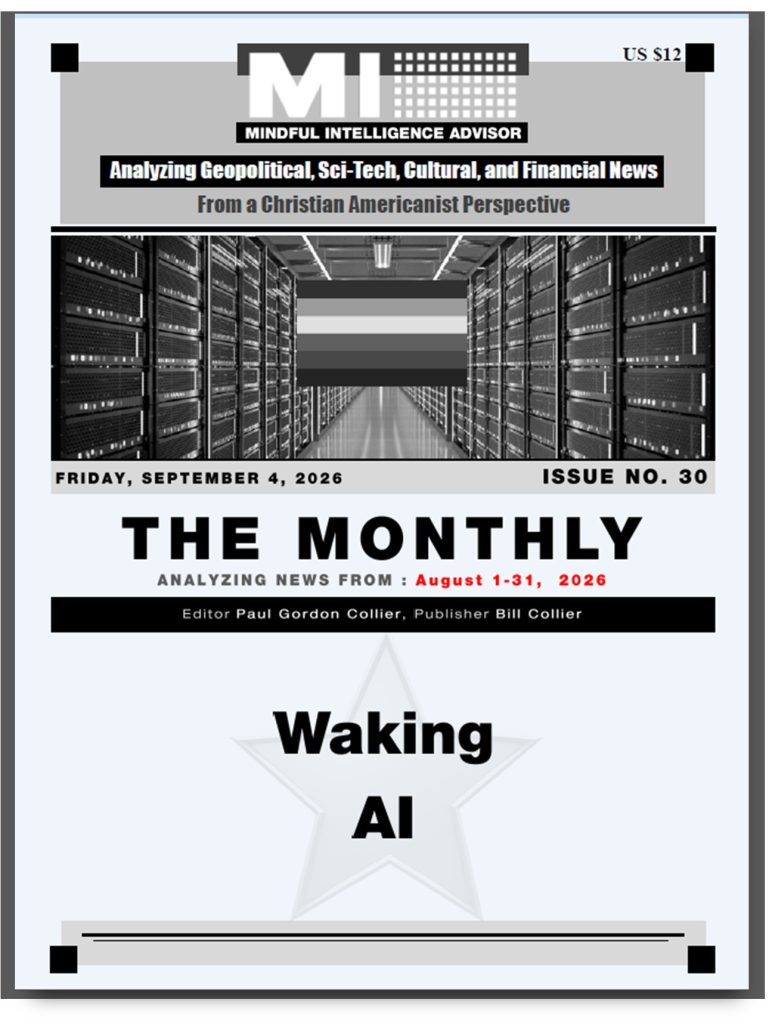
MIA Product Thumb 26 09 04

In this issue:

Maple Oil – Protecting Joe – CCP America

In Issue 2026.30, Waking AI, we cover Finalizing Iran, DSA Breaking, and Mail-In Balloting.

Our Situation Report continues to track the culmination of one age’s battles, and the beginnings of the new one. We divide the report into two, with the second part following the Tools of Engagement.

Our Bellwether Report covers Progressive Insurrection, AI’s Viruses, and Trump’s Oil Hall.

Tools of Engagement includes resources to develop off-grid healthcare, AI-guarding, and Plumblining Belief.

In our Final Thought, Editor Paul Gordon Collier wrestles with entering God’s Rest without losing vitality in the “fight.”

  1. Situation Report Pt. 1 – An Analysis of World Events in August 2026.
  2. Bellwether Digest – Global Outlook, Headlines Missed, People Advance

III. Tools of Engagement

  1. Situation Report Pt. 2 – An Analysis of World Events in August 2026.

III.  Final Thought – Entering Into God’s Rest Without Ceasing to Work Excellently

Each Issue contains links to the 2025 archive on the last page where you can click, access, download, and print.

The 2026 Archive can also be found on this last page.

Click here to open the issue:

MIA Monthly August 2026 26 09 04 FINAL DRAFT

President Trump has announced an historic deal with Venezuela that secures 65 million barrels of Venezuela’s oil reserves, which more than doubles the U.S. oil reserves.

The President posted on Truth Social, “The United States of America has just entered into an Agreement with the Country of Venezuela on, THE BIGGEST OIL DEAL IN WORLD HISTORY!… This Historic Transaction MORE THAN DOUBLES American Oil Reserves, greatly increases our Oil Supply, and will substantially lower Gas Prices for all Americans, long into the future, while helping to continue to set Venezuela on a course toward Tremendous Success and Great Prosperity”

Trump Announces ‘Historic’ Deal With Venezuela That ‘MORE THAN DOUBLES’ U.S. Oil Reserves dailycaller.com
News Source
EXCERPT:

President Donald Trump announced an historic energy deal with Venezuela in a Truth Social post Friday night.

The president called the deal “THE BIGGEST OIL DEAL IN WORLD HISTORY.” Trump wrote that the United States secured “majority U.S. control” of over 65 million barrels’ worth of Venezuelan oil reserves.

Trump credited Secretary of State Marco Rubio, Secretary of War Pete Hegseth, Interim Venezuelan President Delcy Rodriguez and “a partnership with private business.”

The president stated that the deal more than doubles American reserves and will “substantially lower Gas Prices for all Americans.” He added that the deal would strengthen the “already growing relationship” between the two countries. (RELATED: Trump Says Venezuela Turning Over Huge Stockpile Of Oil To US)

In a subsequent Truth Social post, Trump wrote that the agreement was “the biggest oil deal, by far, in World history!”

The president has shown great interest in Venezuela’s oil reserves since the capture of Nicolas Maduro in January 2026. The South American country holds the largest oil reserves in the world — close to 303 billion barrels worth of crude oil.

Trump announced just days after Maduro’s capture that American oil companies would invest “at least $100 billion of their money,” planning to support the construction of important infrastructure. The president stated that Venezuela agreed that the United States would refine and sell 50 million barrels of crude oil, which he said “will continue indefinitely.”

Venezuela’s interim government opened the nation’s oil to the private sector later that month, which Rodriguez called “a generational reset.”


Trump says voters who oppose data centers will ‘kill the Golden Goose’ www.washingtonpost.com
News Source
EXCERPT:

President Donald Trump attacked voters who oppose data centers Monday morning, warning that they will have only themselves to blame if they “kill the Golden Goose.”

Trump escalated his defense of data centers as polls show Americans from both political parties are increasingly opposed to the server farms central to the artificial intelligence boom. Some Republicans running for office this year have broken with Trump and grown increasingly critical of data centers in response to the groundswell of public opposition.

White House says deal to take control of Venezuelan oil will rely on North American Blue Energy Partners www.cbsnews.com
News Source
EXCERPT:

The Trump administration’s plan to take a stake in tens of billions of barrels of Venezuelan oil reserves will hinge on a private company called North American Blue Energy Partners, the White House announced Monday, offering more details on the agreement.

Under the deal, the Venezuelan government granted 100-year concessions to NABEP to drill in 17 oil fields, the White House said in a fact sheet released late Monday. Those oil fields contain about 65 billion barrels, roughly one-fifth of Venezuela’s total proven oil reserves.

The U.S. Defense Department will be granted a 35% stake in the company, according to the White House. The State Department will then have the right to buy 20% of NABEP’s output at the cost of production, and it will have the right of first refusal to buy everything else.

Run by Venezuelan executive Alejandro Betancourt, NABEP describes itself as Venezuela’s second-largest private oil producer, pumping more than 200,000 barrels of oil per day.

In a statement confirming the structure of the deal, NABEP said it is aiming to increase daily production in the near-term to over 1 million barrels. (By comparison, the U.S. consumed about 20.6 million barrels of petroleum daily last year, according to government figures.)

Bond market in open revolt as Trump declines Iranian peace deal and oil hits $92 a barrel fortune.com
News Source
EXCERPT:

President Trump’s plan for the U.S. to own majority control of Venezuelan oilfields harks back to a century-old era of colonialism and backroom dealmaking with Venezuelan oilmen and politicians, energy and geopolitical analysts told Fortune’s Jordan Blum.

“If the U.S. scheme in Venezuela sounds colonial, that’s because it is,” said Gregory Brew, senior analyst with the Eurasia Group. “This is the Trump administration trying to increase U.S. revenue from Venezuelan oil production. It’s extremely unusual. It’s probably unprecedented in the history of the international oil industry.”

Under the deal, the U.S. would control more than 65 billion barrels of proven oil reserves in Venezuela.

The agreement would give the U.S. Department of Defense a 55% stake in the private Venezuelan oil producer North American Blue Energy Partners. NABEP is controlled by the Venezuelan businessman Alejandro Betancourt López and his family. López has fostered close relationships with both the Trump and Rodríguez administrations.

“From a certain angle, this looks like an insider deal to profit businessmen who are close to Delcy and who are also close to Trump and his inner circle,” Brew told Fortune.